Financial Strategy
The Financial Strategy is our 5-year plan that sets out how we will manage our finances to deliver services, meet community needs and stay financially sustainable. It covers the years 2026/27 to 2030/31. Councillors will consider the plan in October 2026.
These pages explain the main points.
Firstly, it is important to understand how the Local Authority budgets work. There are four main budget areas:
Housing
- Housing investments
- Housing Revenue Account
General Fund
- Investment in Schools, Roads, and other Council Assets
- General Fund Revenue Account
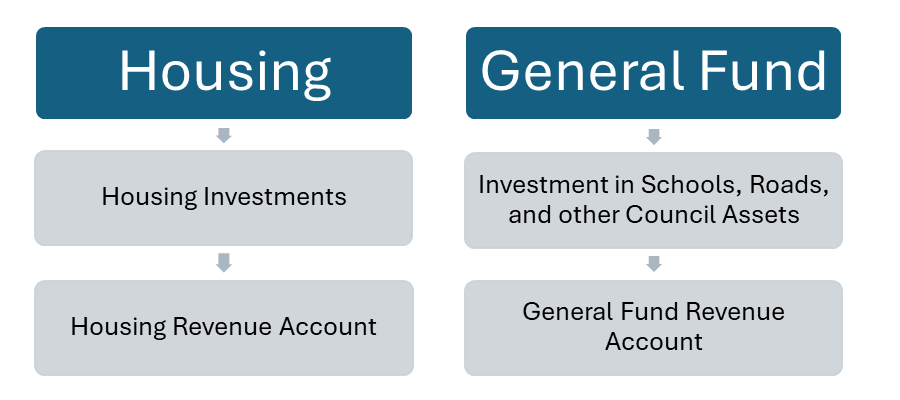
The Housing Budget is ring-fenced to manage council owned housing stock. The General Fund is the main account we use to manage the majority of public services.
Both the Housing Budget and the General Fund Budget are then split into two budgets – revenue and capital. Revenue is for day to day running costs and expenditure. This includes salaries, energy costs and repairs. Capital is generally expenditure and investment in assets (i.e. road improvements, new buildings and equipment.
It is important to note that money for day to day spend and money for investing in assets must be kept separate.
The Financial Strategy focuses on the General Fund.
What is the General Fund?
The Council delivers hundreds of services to our communities – services that people rely on. These include educating our children and young people, supporting people with disabilities and long-term conditions, benefit support and looking after our area through, road surfacing, streetlights, bin collection,planning applications, and sports and leisure activities. The Council is a big organisation and the budget to deliver these services is around £508million in 2026/27.
Falkirk has a population of 160,000 people and the Council is there to provide services to those who need them. This includes:
- delivering Education to circa 24,000 children (including early years)
- operating 8 libraries
- looking after circa 1,000km of roads and over 1,000 km of footways and paths
- collecting waste from more than 78,000 households
- supporting more than 1.8 million visits to sports and leisure facilities
What does the Council spend money on?
The General Fund Revenue Budget pays for:
- Staff wages – teachers, social workers, bin crews, benefit advisors, sports staff, plus support staff like payroll and HR.
- Buildings – rates, rent, gas, electricity and maintenance.
- Services from others – for example, paying independent foster carers when the Council doesn’t have enough of its own.
- Transport, supplies and food – such as school meals and school transport.
Where does the Council’s money come from?
Scottish Government
Around 78.5% of our budget comes from the Scottish Government through a grant.
However, sometimes the Government can put conditions or restrictions on what the grant is spent on. In the last couple of years for example, the Government has asked Councils to maintain a specific number of teachers. Teachers make up 25% of the General Fund budget, so that is a big slice of the budget that we can’t control or change.
The Government might also give us money for a specific policy or project. For example, the Government provides money called the Whole Family Wellbeing Fund which invests in holistic family support to ensure that families can get the help they need, where and when they need it, avoiding problems reaching crisis point.
The Council must use this money for the purposes set out by the Government.
Council Tax
The Council gets around 18.5% of its income from Council Tax and we must set this each year by 11 March. Sometimes the Scottish Government may put restrictions on whether the Council can increase Council Tax or by how much.
A 1% increase in Council Tax gives the Council around £900,000 in a year. For a £488 million budget, this means that a 1% Council Tax increase only increases our budget by around 0.2%.
Fees and Charges
The Council gets around 3% of its budget from fees and charges. These are charges that the Council is allowed to set and includes areas such as garden waste bins, parking, entry to swimming pools and hall lets. A 1% increase in fees and charges only increases the Council’s budget by around £200,000, or 0.04%.
Together, this means the Council only directly controls about one fifth of its income, and even then, there can be restrictions.
Why does the Council have a Financial Challenge?
Just like your household budgets, the Council’s costs to deliver services have increased significantly over the last few years. That is through pressures like inflation (cost of fuel and food), increases in interest rates, which means our borrowing costs more, and pay increases. Pay increases are set nationally so the Council cannot directly control these.
The Council’s income has not increased in line with its costs. Even if Council Tax rose by 7% each year, the budget gap would still be around £6–8 million a year.
The only things we as a Council can do to balance the budget are:
- Spend less – by changing, reducing or stopping some services
- Raise more income – through Council Tax or charges, though this only covers a small share of the budget
- Request more Government funding – though national budgets are also under pressure
Does the Council have to balance the budget?
Yes – the Council is legally required to set a balanced budget each year.
It cannot borrow to pay for day-to-day services.
It can borrow for big capital projects like schools or road works, but repayments then come out of future budgets. It works much like a household. You would not want to take out a loan to pay for food or heating, but you might borrow for a car or mortgage, and the repayments must come out of your income.
Why is the Council investing in projects like the Town Hall or Westfield Roundabout when money is tight?
As mentioned earlier, the General Fund has two elements, the Revenue budget and the Capital Budget. The first is the day to day budget which pays for services such as schools, social care and waste collection. This is known as our Revenue Budget.
The second is the Capital Budget which is used to invest in assets and big projects such as new schools, road improvements or major building works.
Legally, these two budgets must stay separate.
The Council must manage many competing priorities. Much of the investment is needed to keep its buildings and infrastructure in good condition so that services can continue. This includes spending on school buildings, social work buildings, offices, roads, streetlights and leisure facilities.
The Council must plan for the future. Investment decisions are not just about what is needed now, but also about the ambitions for the local area in the future.
Falkirk Town Hall
Falkirk Council has traditionally operated a theatre in the Falkirk area to meet the cultural demand of the residents in this area. The Council also requires a chamber in which elected members and officers can undertake Committee meetings that are critical to the business of the organisation. The previous theatre and chamber had to close due to the poor condition of the buildings and these need to be replaced. This major investment will bring significant benefits as the new Falkirk Town Hall will help to regenerate Falkirk town centre which has suffered, like most high streets in the UK, from the decline in retail in the past two decades. The Council has recently undertaken a major public consultation into the new Town Hall and the details of this will be shared in the coming months.
Westfield Roundabout
This massive infrastructure project is being delivered at no cost to local residents. This is because the funding is being provided by the UK Government’s Levelling Up Fund, as well as an innovative scheme called Tax Incremental Funding (TiF) whereby the Council can retain business rates from the local area. This major investment will bring big benefits by improving the road and footpath network in that area which is exceptionally busy – particularly with heavy vehicles such as lorries - due to the surrounding Stadium, Helix Park, motorway links, industrial complexes and the future Retail Park. Under the strict rules of the Levelling Up Fund and TiF, the money going towards this project cannot be moved to anything else, or be used to help pay for the Council’s day to day running costs.
What’s Next?
In line with all other Councils across Scotland, it is expected that our financial pressures will continue for at least the next five years
To deal with this, we will have to:
- Find new ways to reduce costs,
- Look at fair options to raise income,
- Explain local financial pressures we face clearly to Government, and
- Involve communities more in decision-making.
At the March 2025 budget meeting, some savings were not approved because Councillors felt there had not been enough consultation. The Council has committed to improving how it involves communities before making changes. This will see in person and online meetings as well as a survey launching in October 2025.