How to manage asbestos containing materials
Up until 1999 asbestos was used in a variety of building products. These asbestos containing materials (ACMs) included ceiling and floor tiles, wall boards, electrical insulation, ceiling and wall coatings, pipe lagging and roofing materials among others. Where ACMs are in good condition and are undisturbed they don't present a significant risk to individuals. If an ACM is damaged asbestos fibres could be released into the air. If inhaled these fibres may present a risk to health.
Anyone managing an activity with the potential to disturb or damage any ACM is responsible for making sure that no one is put at risk from exposure to asbestos fibres; whether at work or using a Council property. This applies to all Falkirk Council workplaces, housing stock and leased properties and all work carried out in them. It also applies to Council employees, contractors undertaking work on the Council’s behalf and anyone likely to be put at risk from work on these premises.
To effectively manage the risks from asbestos Falkirk Council will:
- take reasonable steps to determine the location and condition of any materials likely to contain asbestos on our premises
- maintain an up to date record of the location and condition of ACMs materials on our premises
- assess the risks of anyone being exposed to fibres from these materials
- ensure arrangements are in place to monitor the condition of ACMs
- implement Asbestos Management Plans for premises to ensure employees or others do not disturb any ACMs present
- provide information on the location and condition of the materials to anyone who is liable to work on or disturb them
- ensure systems are in place to manage any works that could involve exposure to asbestos fibres
- ensure emergency arrangements are in place to deal with the accidental release of any asbestos fibres
- provide employees with appropriate information, instruction and training to safeguard themselves and others
- appoint competent person(s) to provide specialist and technical advice on the management of ACMs in our premises
Falkirk Council will comply with the requirements set out in HSE L143 Control of Asbestos 2012 Regulations for non-domestic properties (Managing and working with asbestos - HSE)
This How To supports is part of the Councils safety management system.
Managing asbestos containing materials
To reduce the likelihood of accidental exposure to asbestos Place Services: Investment, Assests & Climate and Corporate & Housing Services will carry out surveys to:
- proactively identify the presence and type of any ACMs
- assess the condition of the ACM and the risk of fibres being released into the air if the ACM is disturbed or damaged
Surveys
There are 2 types of survey the council will have undertaken in their premises. These surveys will be carried out in accordance with HSG264: Asbestos – The Survey Guide( Asbestos: The survey guide - HSE) they are:
Management Survey: The main aim of a management survey is to allow the duty holder, to produce an asbestos register and an asbestos management plan.
It will help manage ACMs during normal occupation and use of the premises.
A management survey should include an inspection of the following areas:
- all rooms, corridors, stairs, basements, cellars, underground rooms and under crofts
- underfloor coverings, above false ceilings (ceiling voids), lofts, inside risers, service ducts and lift shafts
- external areas including roofs, soffits, gutters and windows
- other areas liable to be disturbed by maintenance activities, for example behind access hatches
Refurbishment/Demolition Survey: There is a legal requirement for all ACMs to be removed, as far as reasonably practicable, before major refurbishment or demolition works.
This type of survey must locate and identify ACMs, including those hidden within the building fabric, before any structural work begins at the premises or on equipment.
A refurbishment or demolition survey must be carried out by a competent surveyor. It involves destructive inspection and potential asbestos disturbance so the area must be vacated during the survey. The surveyor must confirm it as 'fit for reoccupation' after the survey.
A refurbishment or demolition survey aims to ensure:
- ACMs are removed, where required, before the work starts
- nobody will be harmed by work on ACMs in the premises or equipment
- such work will be done safely by an appropriate contractor
Surveys will provide an assessment of the potential for exposure to asbestos fibres and will include recommendations for managing each ACM identified.
Risks of exposure will vary with circumstances and can arise from:
- normal day-to-day occupation and maintenance activities
- damage or disturbance during repair, refurbishment or demolition of premises
This will be used to produce a management plan to detail and record what actions are needed to manage each ACM identified
Selecting A Competent Survey Company
Falkirk Council will use the Scotland Excel Framework for Asbestos Related Works And Services to select the relevant companies to undertake survey works.
All companies who can be called off from the framework are United Kingdom Accreditation Service (UKAS) accredited to ISO 17020.
UKAS is currently the sole recognised accreditation body in Great Britain for asbestos bodies carrying out surveys.
By being UKAS accredited this gives an assurance to the council that an independent and authoritative body has assessed the technical competence of an organisation, including its underpinning management system. The scheme should ensure that the organisation can provide specialist and technical advice for the services specified on its schedule of accreditation.
Premises Manager's Handbook
No employee or contractor should be permitted to undertake any work with the potential to disturb or damage ACMs without first checking a current survey report.
Surveys will provide an assessment of the potential for exposure to asbestos fibres and will include recommendations for managing each ACM identified.
Copies of survey reports and management plans can be requested from asbestosdevserv@falkirk.gov.uk.
For housing stock Supervisors must ensure that details from a survey are included with the work line before any work begins. If this information hasn't been provided you can request it from asbestos@falkirk.gov.uk.
Work must not begin until information on any ACMs that may be present has been provided.
Where Falkirk Council has leased a non-domestic property to another party a copy of the Management Survey and Reinspection Survey will be made available to the leaseholder.
The Head of Asset Management Services will ensure that any responsibilities in relation to asbestos management are clearly defined in the lease.
Asbestos Register
The results from Management and Refurbishment/Demolition Surveys will be held in an Asbestos Register.
Separate Registers are maintained for Place Services: Investment, Assests & Climate and Transformation, Communities & Corporate Services by:
Compliance Officer – Asbestos
Divisional Technical Co-ordinator
They will ensure systems are in place for:
- All Council properties to have a Management Survey
- a periodic review and update of Management Surveys (Annual Reinspection Report)
- implementing recommendations from Management Surveys & Reinspection Reports developing Asbestos Management Plans for Council premises
- sharing Management Survey reports and Asbestos Management Plans with Premises Managers
- updating the Asbestos Register
To reduce the likelihood of accidental exposure to asbestos Place Services: Investment, Assests & Climate and Corporate & Housing Services will carry out surveys to:
- proactively identify the presence and type of any ACMs
- assess the condition of the ACM and the risk of fibres being released into the air if the ACM is disturbed or damaged
Work Involving Asbestos Containing Materials
Any work that could damage or disturb an ACM will carry the same hazard to health. But the likelihood that asbestos fibres will be released can vary depending on the material, its condition and the work that's being done.
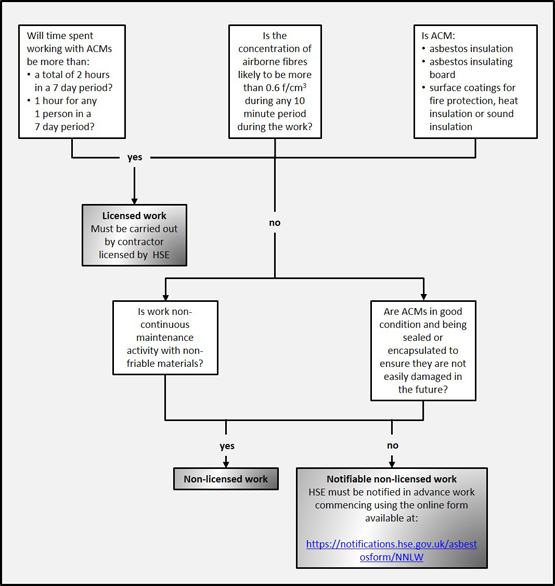
Work involving ACMs falls into three categories: licensed, non-licensed and notifiable non-licensed.
Licensed Work
Licensed Work is higher-risk work that must only be done by a contractor licensed by the Health and Safety Executive (HSE).
Work that needs to be licensed is typically where a risk assessment:
- shows work isn't short duration or exposure to asbestos isn't likely to be sporadic and of low intensity
- can't clearly demonstrate that the control limit won't be exceeded. The control limit is 0.1 fibres per cubic centimetre (f/cm3) airborne fibres averaged over a four-hour period
- identifies asbestos insulation or asbestos insulating board or surface coatings which contain asbestos for fire protection, heat insulation or sound insulation
Short-duration work is where the total time spent by all persons working with ACMs is no more than two hours in a seven-day period and no more than one hour in a seven-day period for any single person. This includes time spent setting up, cleaning and clearing up,
For exposure to be considered sporadic and of low intensity the concentration of asbestos fibres in the atmosphere shouldn't exceed 0.6 f/cm3 in the air measured over any ten-minute period for duration of the work.
Examples of licensed work include:
- removing sprayed coatings
- removal or other work which may disturb pipe lagging
- any work involving loose fill insulation
- work on asbestos millboard
- cleaning up significant quantities of loose or fine debris containing ACM dust where work isn't short duration and exposure isn't sporadic and of low intensity
- work on Asbestos Insulating Board where the risk assessment indicates it won't be short duration
More information on licensed work is available at HSE | Licensable work with asbestos.
Notifiable Non-licensed Work
Work may be short duration, exposure to asbestos may be sporadic and of low intensity and not exceed control limits but doesn't satisfy the other conditions for non-licensed work.
This is notifiable non-licensed work and must be notified to the HSE before work begins using the online form ASB NNLW1 - Notification of non-licensed work with asbestos.
Examples of notifiable non-licensed work include:
- maintenance work on friable materials like drilling holes to attach fittings or pass cables through
- any work which disturbs materials that are more friable
- repairs to asbestos insulation like minor damage to a small section of insulation where the exterior coating has been broken or damaged
- work on ACMs that are deteriorating or significantly damaged and more likely to release fibres
More information on notifiable non-licensed work is available at HSE | Notifiable Non-Licensed Work (NNLW).
Figure 1 gives an indication of what should be licensed, non-licensed or notifiable non-licensed work.
Notifiable non-licensed work must be carried out by a competent contractor.
Non-licensed Work
Lower risk work may not need to be carried out by a licensed contractor if it is:
- a short non-continuous maintenance task, with only non-friable materials. Friability describes how likely an ACM is to release asbestos fibres when worked on so non-friable materials will only release a small number of fibres during work
- a task where the ACMs are in good condition and are being sealed or encapsulated to protect them
- This type of non-licensed work can include:
- cleaning up small quantities of loose or fine debris containing ACM dust where the work is sporadic and of low intensity, the control limit won't be exceeded, and it is short duration work
- drilling of textured decorative coatings for installation of fixtures/fittings
- encapsulation and sealing-in work on asbestos-containing materials (ACMs) that are in good condition
More information on non-licensed work is available at HSE | Non-licensed work with asbestos.
Any non-licensed work involving the removal of ACMs must be carried out by a competent contractor.
Before deciding whether non-licensed work is notifiable or whether employees or contractors are competent to carry out any form of non-licensed work you should contact:
Compliance Officer - Asbestos
Divisional Technical Co-ordinator
Disposal of ACMs
All ACM wastes should be collected by a registered waste carrier for disposal at an appropriate licensed disposal site. No employee will remove ACM wastes from a premises or work site.
For more information on the disposal of ACMs contact:
Divisional Technical Co-ordinator
Written Plan of Work
Any work activity with the potential to disturb or damage an ACM will require a written Plan of Work which details:
- the nature and expected duration of the work, the number of people involved in the work and the address and location where the work is to be carried out
- a suitable and sufficient assessment of risks from the damage or disturbance of ACMs or debris
- a Method Statement detailing control measures for managing the risks identified, arrangements for keeping premises and plant clean and arrangements for the handling and disposal of asbestos waste
- emergency arrangements for managing any unplanned release of asbestos fibres resulting from any work involving ACMs
- any requirements for air monitoring as indicated by the risk assessment. Asbestos related sampling and analysis for monitoring purposes must only be carried out by laboratories accredited to ISO 17025 by a recognised accreditation body
In the case of demolition or a major refurbishment the Plan of Work must include arrangements for the removal of all ACMs before work begins where this is reasonably practicable.
For work carried out by an external contractor they are responsible for preparing a written Plan of Work.
Where non-licensed work is to be carried out by Council employees the Plan of Work must be written by a suitably competent employee. For advice on completing a written Plan of Work you should contact:
Divisional Technical Co-ordinator
Services must make sure arrangements in place to ensure that work is carried out in according to the Plan of Work.
The Plan of Work is a working document and should be reviewed and updated if:
- there has been a significant change to work tasks particularly those used to control fibre release
- the amount of asbestos found or the results of any air monitoring show exposure levels may be higher than originally assessed
- the duration of the task is longer than originally assessed
- there has been an incident or near miss
Training
Line Managers will ensure relevant information, instruction and training is provided to any employee whose role is likely to bring them into contact with ACMs or involve the management of ACMs. This will include any procedures to be followed if ACMs are accidently damaged or disturbed. Appropriate training will be made available to all employees whether new or existing and will be refreshed at regular intervals.
As a minimum any employee whose role might bring them into contact with ACMs must undertake Asbestos Awareness training. This training should be refreshed at least annually.
For more information on specific training requirements for individual roles contact:
Unexpected discovery of asbestos containing materials
You will need to take immediate action if you discover:
- damaged material that you suspect could contain asbestos
- an item or piece of equipment that you suspect could have been made with a material that contains asbestos
You must:
- stop all activities in the area and do not move or touch any suspect material or item
- leave the area
- put up a warning sign and make sure nobody enters the area
- contact one of the following for further instruction:
Health Surveillance & Reporting an Exposure
Many cases of inadvertent, short-term exposure to asbestos will most likely have led to minimal exposure to fibres, with little likelihood of any long-term ill health effects; although there may be little reliable information available at the time about the actual level of exposure
Any employee who believes they may have been exposed to asbestos and is concerned about the possible effects on their health should be advised to consult their GP and ask for a note to be made on their personal record about possible exposure including date(s), duration, type of asbestos and likely exposure levels.Any such exposure must be reported by the employee using the EVOTIX Assure Employee Portal.
Affected employees can also ask their line manager to be referred to the Council's occupational health provider for support and guidance and ask for a note to be made on their personal record about possible exposure. Results for any air monitoring should also be provided to the occupational health provider to be filed along with the affected employee’s medical notes.
Asbestos-related damage to the lungs takes years to develop and become detectable. Even x-ray examinations cannot indicate whether or not asbestos fibres have been inhaled.
If an employee is diagnosed with an asbestos-related condition redeployment may be considered in line with the Capability Policy and Redeployment Policy. Their line manager should seek advice from Occupational Health and HR and discuss the options available. Health surveillance requirements for any co-workers of the affected employee should also be reassessed.
Occupational Health will retain records of examinations for 40 years after the date of last entry.
Roles & Responsibilities
Chief Executive Officer
The Chief Executive Officer is the ultimate duty holder regarding asbestos management within the council. They are also responsible for ensuring that adequate resources are available to implement appropriate procedures, train key personnel, meet the sampling/testing requirements and ensure appropriate protective measures are taken. This responsibility is then further delegated to officers engaged in the immediate management of asbestos within the council.
Head of Place Services: Investments, Assets & Climate
This role has the delegated responsibility to act as the duty holder for all operational properties and common areas of housing properties within the Council's portfolio.
Property Compliance Manager
Is the Councils Responsible Person for Asbestos Management in operational properties. In addition to, for operational properties, they will
- Ensure Competent person(s) are appointed to provide support and guidance in all aspects of asbestos management in their services areas of responsibility
- A suitable and sufficient assessment is carried out as to whether asbestos is, or is liable to be present in each of the premises
- Ensure a risk assessment is undertaken for those premises where asbestos is, or is liable to be present, are appropriately maintained and provided to Premises Managers
- Ensure an audit programme is in place for the Premises Manager Handbook that covers asbestos management
- Provide regular updates on Asbestos Management to the Property Compliance Board and Custodian Service Liaison Meetings, as agreed with the Head of Investment, Assets & Climate
- Head any response to confirmed or suspected asbestos disturbance and instances of significant failure of the asbestos management arrangements in place.
Building Design Manager
The building design manager will:
- Ensure that all design projects are undertaken in line with the Asbestos How To document and that information regarding work on ACMs is relayed to the relevant officer and recorded in the Asbestos Register of the property as soon as the work is complete
- Where the design project has implications for room reference numbers held on the Asbestos Register, the Design manager will also ensure that new, single line or CAD drawings are forwarded to the relevant division as soon as possible to allow them to update the Asbestos Register and, where appropriate, amend room reference numbers
Manager (Asset Management)
The Manager (Asset Management) will:
- Ensure there is a process for those leasing commercial properties from the Council to receive relevant information related to ACMs within the buildings.
Compliance Officer – Asbestos
The Compliance Officer - Asbestos will:
- Ensure asbestos surveys meet the requirements of Falkirk Council
- Develop and maintain an Asbestos Management Plan/Asbestos Register for commercial premises throughout the council portfolio
- Act as the Council's competent person for asbestos management
- Ensure the Councils electronic management system (Profess) is kept up to date and in order along with the property standards team
Asset & Investment Service Manager
The Asset & Investment Service Manager will
- Ensure that there are processes in place for managing information and undertaking surveys of regarding Council housing stock
Building & Maintenance Division Manager
The Building & Maintenance Division Manager will:
- Ensure that any works undertaken by BMD employees meeting the requirements of this How To
Premises Managers
Premises managers play a key role in managing asbestos materials that may be present within Council properties. They will:
- Ensure they have access to the most accurate, up to date version of the Asbestos Management Plan/Asbestos Register for the property
- Ensure that information about the location and condition of ACMs is communicated to every person liable to disturb it and, where required, to the emergency services
- The premises manager is responsible for the development of a local procedure to monitor ACMs for vandalism or damage. This procedure must also ensure that no work on ACMs is undertaken within their premises without the prior authorisation of Place Services - Investments, Assets & Climate
- The premises manager is also responsible for ensuring that appropriate action is taken if any asbestos material is disturbed or damaged
Employees
In a Council workplace where there is known or presumed to be asbestos a Council employees will:
- Follow any local guidance regarding attaching objects or items to walls or other areas that may contain asbestos.
- Not willingly or knowingly damage or disturb any ACM or asbestos fibres, unless competent to do so and there type or work is appropriate for the employee to perform.
- Report any signs of deterioration or damage to ACMs they are aware of
Monitoring & Review
The Property Compliance Manager will review this when there are relevant chances to regulations or material changes to gas safety activities within the Council. Where there are changes to gas safety activities within the Council the relevant work area should notify the Property Compliance Manager.
Relevant Legislation
Health & Safety at Work Act 1974
Control of Asbestos Regulations 2012
Construction (Design and Management) Regulations 2015
Duty to Manage Asbestos – Approved Code of Practice (L143)