How to prevent and manage occupational violence and unacceptable actions
Everyone has the right to feel safe at work. Falkirk Council will take steps to reduce risks, provide support after incidents and make safety and wellbeing a priority. Employees should be empowered to report concerns without fear of reprisal and can expect that all reports will be taken seriously and addressed in line with established procedures.
Equally, while it can be challenging to maintain impartiality when a service user exhibits violent, dysregulated or otherwise unacceptable behaviour, it remains essential that all individuals are treated with dignity and respect.
Incidents covered by this guidance may involve members of the public or occur between employees. Both scenarios must be managed with equal seriousness.
Definitions
Occupational violence
Falkirk Council defines occupational violence as:
'Any incident in which a person is abused, threatened or assaulted in circumstances relating to their work.'
This can include acts of physical violence or verbal threats of violence. Incidents of occupational violence don’t just have to occur within the workplace, instances where an employee experiences occupational violence that are not in the workplace but related to their work such as an employee is identified in public and abused or assaulted due to the role is considered to be occupational violence.
There is an intent to cause harm or a credible risk to an employee’s safety.
Distressed or dysregulated Behaviour
Falkirk Council defines incidents involving distressed or dysregulated behaviour to be where someone is harmed as a result of behaviours exhibited by an individual which may be related to an underlying medical condition, additional support needs or someone experiencing a significant crisis. The individual exhibiting these behaviours does not have an intent to cause specific harm to the injured individual. Distressed or dysregulated behaviours can be either physical or verbal.
Unacceptable action
An unacceptable action is something an individual does that breaks the rules and expectations of behaviour. This categorisation should be used for incidents that happen to employees and can either be caused by behaviours of other employees or members of the public. These expectations can be established either through Council policies such as the Dignity at Work Policy or agreements with service users such as tenancy agreements. Examples of unacceptable action can include:
- harassment (including sexual harassment)
- bullying
- threats or abusive language
- use of discriminatory or prejudicial language
The use of social media to target Falkirk Council employees constitutes an unacceptable action and should be treated with the same seriousness as other forms of harassment or abuse.
While most service users engage appropriately, a small number may place undue pressure on employees by making excessive or unreasonable demands. These can include
- requesting large volumes of information
- expecting services beyond what can reasonably be provided
- insisting on immediate responses
- demonstrating persistent refusal to accept decisions or explanations
- continuing to contact staff even after a matter has been formally closed
In addition to disrupting service delivery, these behaviours can negatively impact employee wellbeing. Head Teachers and Service Managers are responsible for ensuring that appropriate procedures are in place to identify, manage, and respond to these situations effectively.
While it can be challenging to maintain impartiality when a service user exhibits violent, dysregulated, or otherwise unacceptable behaviour, it remains essential that all individuals are treated with dignity and respect. Wherever feasible, this principle should be clearly communicated to reinforce expectations and uphold professional standards.
Risk factors
Factors that can increase the likelihood and risks of an employee being exposed to violence, dysregulated or distressed behaviour or unacceptable actions include:
- providing care or services to people who have additional support needs, are distressed, confused, afraid, ill, affected by drugs or alcohol, homeless or receiving unwelcome or coercive treatment
- providing statutory educational or care services with users who (or have been known to) display or act in a violent manner, not due to distress or dysregulated behaviour
- enforcement activities, e.g. Environmental Health or Building Standards
- involvement in litigation or regulatory procedures on behalf of the Council facing threats or harassment from unreasonable defenders or third parties, e.g. employees acting as solicitors instructing officers or witnesses in court actions.
- working in high crime areas
- high pressure work environments
- organisational challenges like unclear procedures, limited support systems and ineffective communication.
- perceived inequalities or previous workplace conflicts that are unresolved
- handling valuable or restricted items e.g. cash or medicines
- the physical work environment e.g. poor lighting or visibility
- working alone, in isolation or in a remote area with the inability to call for assistance
- working offsite or in the community
- working in unpredictable environments e.g. where other people may pose a risk to workers’ safety such as at a client’s home
- interacting with customers including face-to-face, on the phone or online
- work environments where unacceptable actions are normalised through the tolerance of bullying, harassment or passive-aggressive behaviour
- in relation to gendered violence, low worker diversity, power imbalances along gendered lines, and a workplace culture which accepts and tolerates gendered violence
- service methods or policies that cause or escalate frustration, anger, misunderstanding or conflict e.g. low staffing levels, customer service policies, setting unreasonable expectations of the services provided by the Council
Service Unit Managers and Head Teachers must ensure that these factors are identified within the work activity risk assessment through the use of violence (work-related), distressed or dysregulated behaviour and unacceptable action hazard categories within the hazard and control measures section of the Activity Risk Assessment.
Work activity risk assessments should be completed on the EVOTIX Assure system.
Preventing and reducing the risk of occupational violence
As part of the work activity risk assessment consideration should be given to what reasonably practicable options are available to either prevent or reduce the exposure of employees to instances of occupational violence within the workplace.
It is important to recognise that incidents are not limited to interactions with the public. Unacceptable actions, occupational violence or dysregulated behaviour can also happen between employees and this guidance applies equally to such situations.
The hierarchy of control should be applied to work activities where occupational violence, distressed or dysregulated behaviour or unacceptable actions are identified as a risk:
Elimination
Eliminating violence, dysregulated or distressed behaviour or unacceptable actions from work activities can be difficult because of the services we are required to deliver. In some cases, it can be appropriate and reasonably practicable to eliminate the risk by:
- providing alternative methods of customer service to eliminate face-to-face interactions e.g. online payments and transactions
- withdrawing service to specific individuals – this may be appropriate where a service is not a statutory service and the service user has not responded to prior attempts to resolve instances of occupational violence
Substitution, isolation and engineering controls
In some cases, it is possible to change the way a service is delivered or the workplace is designed to reduce the risk of occupational violence. Examples of these options include:
- no longer providing face to face services to specific individuals – this may reduce the risk of physical violence to employees, however there may still be residual risks associated with verbal threats of violence
- separating workers from the public with fixed or removable barriers such as high counters, furniture, screens on counters or screens between a driver and passenger
- controlling access to the premises e.g. electronically controlled doors with viewing panels that allow surveillance of public areas before the doors are opened from the inside
Administrative controls
Administrative controls include work systems and procedures that support other approaches to reducing or preventing occupational violence. These can include:
- managing expectations of clients and customers by clearly communicating the nature of the products or services you are providing e.g. online and using signage
- implementing safe cash handling procedures
- reducing waiting times and missed calls
- regular handover and information exchange with workers, other agencies, carers and service providers
- clearly communicating to clients and customers that any form of violence, harassment or abuse is not tolerated e.g. in service agreements, contracts or on signs
- training workers in how to deal with difficult customers, conflict resolution, when and how to escalate issues to senior workers, and procedures to report incidents. Training must be mandatory where risk assessments identify a significant risk to employees, role-specific based on a training needs analysis and refreshed regularly.
- training managers and supervisors to identify early signs of conflict or distress and respond appropriately
- providing lone working devices for lone workers where there is a risk of occupational violence
- sending employees in pairs to undertake visits
- clearly communicating to all employees what constitutes unacceptable behaviours in the workplace and the consequences
- establishing clear procedures for identifying, managing and responding to unacceptable actions and ensuring employees are trained to respond appropriately in these situations in line with these procedures.
Incident Reporting
Incidents involving occupational violence, distressed or dysregulated behaviour, or unacceptable actions towards employees must be reported using the EVOTIX Assure Employee Portal, unless there are other clearly established reporting pathways agreed with the relevant work area, Trade Unions and the Human Resources & Payroll Team. These incidents should be reported by the employee unless there is a clear reason they cannot report the incident (employee incapacitation for example).
Employees must be supported to complete incident reports during working hours. Line managers must ensure time is allocated for reporting and that staff are not discouraged from using EVOTIX. Incident reporting is an essential part of the Council’s safety process and employees should not be expected to complete it on their own time.
In these instances, line managers will ensure these reporting pathways are communicated to employees and the above stakeholders following their agreement for implementation.
Incident investigation
Any investigation conducted for incidents reported on the EVOTIX Assure system by the relevant manager should be recorded in the Initial Investigation Section.
For incidents involving lost time (the employee is absent from work for any period due to the incident) a detailed investigation must be completed by the manager assigned the investigation via EVOTIX Assure using the Occupational Violence (lost time) questionnaire in the Detailed Investigation section of the incident report. Additionally, the risk assessment and control measures must be reviewed, and updated where necessary, following a lost time incident.

The Reporting of Injuries, Diseases and Dangerous Occurrences Regulations 2013 (RIDDOR)
The Reporting of Injuries, Diseases and Dangerous Occurrences Regulations 2013 (RIDDOR) requires that certain work-related incidents be reported to the Health and Safety Executive (HSE). These include:
- an employee suffering any one of the injuries listed in Regulation 4(1) of the Regulations
- an employee suffering any injury resulting in absence from normal work duties for more than seven consecutive days
- injures to a member of the public being injured that result in them being taken directly from the scene of the incident to a hospital for treatment
- fatalities arising from work related activities
When such an incident occurs, the manager assigned the investigation via EVOTIX Assure must promptly contact the Health, Safety and Wellbeing Team. The Health, Safety and Wellbeing Team will lead the investigation and provide guidance on whether and how the incident should be reported to the HSE.
Post-incident support
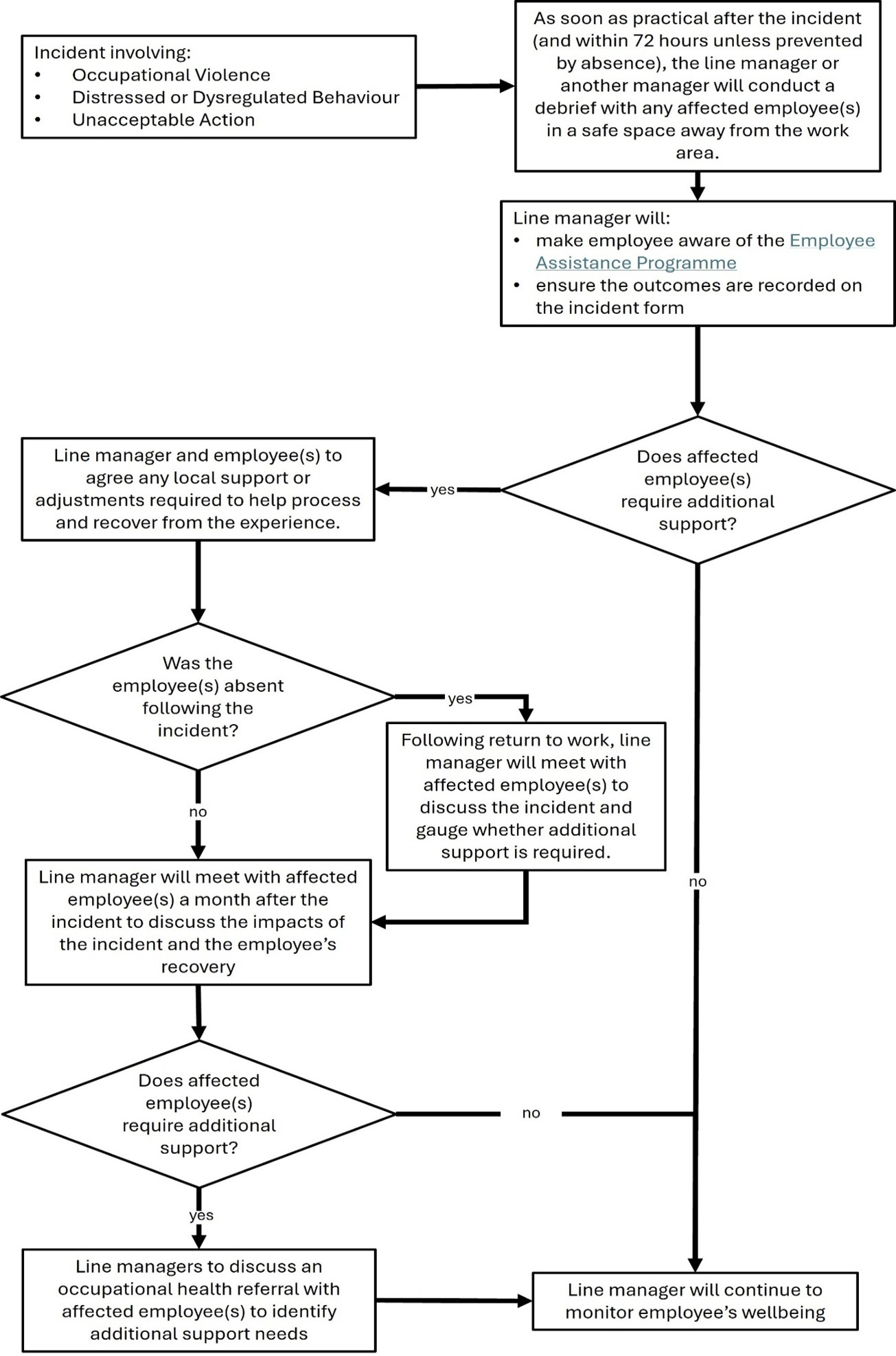
Any Falkirk Council employee involved in an incident involving violence, dysregulated or distressed behaviour or unacceptable actions should receive a debrief following the incident by either their line manager or another senior employee within the work area. This will be carried out as soon as practical after the incident and within 72 hours unless prevented by absence. This should be recorded as being completed on the Incident Report form in the EVOTIX Assure system and any relevant completed documents such as notes from the debrief should be attached to the incident report as a pdf file.
Falkirk Council’s Employee Assistance Programme offers confidential professional counselling and wellbeing resources to help employees recover from the impact of occupational violence, distressed or dysregulated behaviour or unacceptable actions. It is available to all employees for immediate and ongoing support.
Line managers should ensure employees are aware of additional support options such as counselling, mental health first aiders and occupational health as required.
Individuals will react differently to incidents involving occupational violence, distressed or dysregulated behaviours or unacceptable actions, so a range of responses can be expected. It is important to recognise that these responses are a natural reaction and people need time to process the experience to be able to return to their previous level of wellbeing (Appendix 1).
During this time, it’s important to maintain as normal a routine and structure as possible but some allowances may be necessary for those affected by the incident.
Employees may require ongoing support to aid their recovery. Line managers should look out for:
- anger and irritability possibly leading to arguments or conflicts
- reduced work performance, due to temporary memory and concentration difficulties
- employees feeling tearful, insecure and nervous
- an initial change in work atmosphere and mood of employees
- employees avoiding certain areas or tasks
- additional requests for time off
If employees display these symptoms, line managers should contact HR to explore available support options.
Any absences following an incident involving violence, dysregulated or distressed behaviour or unacceptable actions should be managed in line with the Managing Sickness Absence Policy.
Falkirk Council acknowledges that employees have the right to report incidents to Police Scotland, regardless of any internal investigation or action being taken by the Council. Where appropriate, and in agreement with the employee, the Council may also pursue civil proceedings as an alternative to, or in addition to, criminal referral where this is considered a practical and effective means of protecting the employee.
Roles and responsibilities
Service Directors, Heads of Service and Chief Officers
Service Directors, Heads of Service and Chief Officers are responsible for ensuring the health and safety of all employees and others in their respective service areas. Service Directors, Heads of Service and Chief Officers will:
- ensure all employees are aware of this document
- ensure that adequate resources are made available within their Services to enable the implementation of this document
- actively promote and uphold the principles of dignity, respect and safety in all aspects of service delivery and employee interaction
Service Unit Managers and Head Teachers
All Head Teachers and managers who have operational responsibility for other employees or for systems and procedures of work will be responsible for ensuring that:
- work activities within their respective work areas are adequately risk assessed and the most appropriate control measures are in place to manage the risks to employees from occupational violence, distressed or dysregulated behaviours and unacceptable actions and ensuring employees are trained to respond appropriately in these situations in line with these controls
- the principles of dignity, respect and safety are embedded into risk assessments and control measures. These values should also be clearly communicated during team meetings, briefings and written guidance
- employees within their respective work areas are aware and understand the outcomes of these risk assessments and ensure employees have access to these risk assessments
- this document is implemented within their respective work areas by ensuring risks from occupational violence, distressed or dysregulated behaviour, and unacceptable actions are managed effectively
- employees within their respective work areas are aware of, and follow, the correct procedures for incident reporting, investigation and post-incident debriefing
- ensure employees and Trade Unions are consulted and engaged with during the risk assessment process
First Line Managers, Team Leaders, Supervisors and Charge-Hands
These employees will have responsibility for implementing and monitoring safe systems of work to achieve good safety management with the Council.
These individuals will lead by example and be champions for Health and Safety within their work environment and are responsible for:
- ensuring the requirements of risk assessments identify occupational violence, distressed or dysregulated behaviour and unacceptable actions where appropriate respective work areas and shared with new and existing employees
- ensuring that unacceptable actions, occupational violence or dysregulated behaviour between employees are identified, managed and resolved promptly
Employees
In order to create a positive and effective culture in regard to health & safety it is vital that all employees of Falkirk Council contribute positively to the successful management of health & safety. Employees will:
- contribute to and follow the safe systems of work established within their work areas related to occupational violence, distressed or dysregulated behaviour and unacceptable actions
- follow work procedures and requirements of risk assessments.
- report incidents covered within this document
Safety Management Group
This group will have the responsibility for overseeing performance and identifying opportunities for improvement. They will do this by:
- monitoring incident occurrences to identify emerging risks.
- making appropriate recommendations to Services Making for improvements in controls, training and communication