Code of Conduct for Driving on Council Business
The Council's Driving at Work Policy applies to all employees who drive at work on Council business. This includes driving as a work activity or travelling between locations in the course of your work.
This Code of Conduct is in accordance with the Council's Driving at Work Policy. Any breaches may be investigated and managed through the Council's Disciplinary Policy.
You should read this Code of Conduct and complete the declaration before driving on Council business using either a personal or Council vehicle. This should be completed in MyView forms. Where you are unable to access MyView forms, a paper copy should be signed and returned to your line manager for saving in your personal file on MyView. The signed declaration confirms you have read and understood the Code.
General rules
These rules apply to all vehicles driven on Council business. This means any Council owned vehicle, Council hired vehicle or your own private vehicle.
Use of Vehicles on Council Business
When using any vehicle (private or Council) you must follow the Council's Travel Hierarchy contained within the Driving at Work Policy. This hierarchy sets out appropriate alternatives to driving on Council business and when these should be used by employees.
Authorisation to Drive
Before driving on Council business, you must complete an annual "Authorisation to Drive at Work" form and have it approved by your line manager.
Falkirk Council Drivers
Prior to driving on Council business you must:
- have a valid driving licence appropriate to the type of vehicle(s) to be driven. More information on driving licence categories is available here
- Have completed a licence check through the council driving licence check system
- not have a medical condition that impacts on your ability to drive at work
- confirm that your eyesight meets the requirements set out in the Highway Code
- not have any driving convictions that would prevent you from driving at work
- be issued with a vehicle tracking ID tag (Fleet Drivers Only)
- Have completed relevant assessment or training for the vehicle being driven. (Fleet Drivers Only).
If you drive a private vehicle on Council business you must also have:
- insurance that is appropriate for business use
- appropriate and valid road tax
- a valid MOT certificate (if the vehicle is more than 3 years old)
It is also advisable that your vehicle has:
- been serviced according to the manufacturer's recommendations
- emergency breakdown cover that will provide roadside assistance or for the vehicle to be towed if a roadside repair is not possible.
Health
You must report anything that could impair your driving abilities immediately to your line manager. This includes any changes in your health, any personal factors or the effects of any medication or intoxicating substance that could affect your ability to drive.
More information on conditions that can affect an individual's suitability for driving can be found https://www.gov.uk/health-conditions-and-driving.
You should have a regular eye-sight test to ensure your vision is of a standard appropriate to driving. Drivers must adhere to DVLA guidance for medicals, this includes undertaking a medical at 45 for occupational drivers (licence category C & D) and every 5 years going forward.
Shorter licences may be issued for medical reasons, further information can be found here General information: assessing fitness to drive - GOV.UK.
Convictions
You must immediately report any endorsement on your licence to your line manager. If you accumulate 8 or more penalty points you may not be allowed to continue to drive for work purposes. This will be managed in line with Council policies and could result in you being redeployed to a non-driving role.
If you are disqualified from driving you must not drive any vehicle on Council business until the endorsement has expired.
Relevant Legislation
You must be aware of and be able to apply the rules in The Highway Code. The Highway Code is available at https://www.gov.uk/guidance/the-highway-code.
Rest Periods
Driving when tired significantly increases the risk of being involved in a collision. Your line manager will provide you with information on how many hours you can drive and the breaks that you need to take. You should organise your work to make sure you are able to take breaks from driving at appropriate intervals.
Smoking
You are not permitted to smoke in any vehicle being used on Council business. This includes your own. This includes the use of e-cigarettes. This includes vapes.
Drugs and Alcohol
It can take several hours for the intoxicating effects of alcohol or drugs to subside. You are not allowed to drive if you are under the influence of alcohol or drugs at any time during the working day.
You should seek advice from your GP when being prescribed drugs of any kind on how they may affect your ability to drive.
You must report anything that could impair your driving abilities immediately to your line manager.
If you are found to have been under the influence of an intoxicating substance while at work it will be investigated under the Council's Disciplinary Policy and may be regarded as gross misconduct.
In-vehicle Technology
The use of in-vehicle technology, like mobile phones, sat nav or audio systems, can distract a driver and increase the risk of accident. You must familiarise yourself with the safe use of in-vehicle systems before starting your journey. The sat nav should be set before your journey commences and any adjustments only made when safely stopped. You should avoid adjusting or operating any equipment while driving.
It's illegal to hold and use a phone, sat nav, tablet, or any device that can send or receive data, while driving or riding a motorcycle. This means you must not use a device in your hand for any reason, whether online or offline. For example, you must not text, make calls, take photos or videos, or browse the web.
The law still applies to you if you're:
- stopped at traffic lights or queuing in traffic
- supervising a learner driver
- driving a car that turns off the engine when you stop moving
- holding and using a device that's offline or in flight mode
Exceptions
You can use a device held in your hand if:
- you need to call 999 or 112 in an emergency and it's unsafe or impractical to stop
- you're safely parked
- you're making a contactless payment in a vehicle that is not moving, for example at a drive-through restaurant
- you're using the device to park your vehicle remotely
Using Devices Hands-free
You can use devices with hands-free access, as long as you do not hold them at any time during usage or block your view of the road and traffic ahead. Hands-free access means using, for example:
- a Bluetooth headset
- voice command
- a dashboard holder or mat
- a windscreen mount
- a built-in sat nav
If suitable hands-free equipment is installed mobile phones may be used. However, using a mobile phone while driving is still a significant distraction even with hands- free equipment. It can increase the likelihood of drivers being involved in a collision. To help keep you and other road users safe you should:
- switch off mobile phones whenever possible while driving and use voicemail facilities.
- not make or receive calls, send or read texts or emails or otherwise use a mobile phone while driving - only pick up and respond to messages when it is safe to do so - It is not reasonable for your supervisor or line manager to expect you to answer your phone whilst driving.
- satisfy normal business needs by checking mobile phones before or after driving or during a break in your journey.
Occupant safety (general guidance)
Seat belts
You must ensure that you and your passengers wear seat belts at all times while driving.
Head restraints
Head restraints for you and your passengers should be adjusted correctly to help protect against whiplash and prevent long term injuries. The top of the head restraint should be level with top of the head and be as close to the back of the head as possible.
Lights
You must use headlights during the hours of darkness or at any times when visibility is reduced; particularly in adverse weather conditions. You should never only use side lights when driving.
Traffic collisions
If you are involved in a traffic collision you must stop, switch off your engine and turn your hazard lights on to alert other road users to your presence.
Your first consideration should be whether the emergency services are needed. If you are able you should provide assistance to anyone else involved so long as it doesn't put you in any danger. Do not move anyone who is injured unless they are in immediate danger.
You should immediately report the incident to the Police if:
- it involves an injury to a member of the public or a Council employee
- it has caused a hazardous situation
- someone leaves the scene without exchanging details
- you suspect the collision was deliberate to make a fraudulent insurance claim
If the Police are involved you must not move any of the vehicles without first getting their approval.
When you're involved in a collision you're obliged to give your name and address to anyone else involved. You should stop and give your details if you crash into something on or near the road even if there aren't any other people involved. If you hit a parked car, for example, you should leave your details on the windscreen.
You should try to collect the following information:
- Names, addresses and contact details from any drivers, passengers and witnesses.
- Insurance details for the other drivers. If they are not the registered keeper of their vehicle find out who is and make a note of their name and address.
- The registration numbers of all vehicles involved, plus a note of each vehicle's colour, make and model.
- The time and date of the collision.
- A sketch showing the positions of the vehicles involved
- A description of the weather conditions, plus anything unusual you notice about the road quality or lighting.
- A list of damage to vehicles and a description of any injuries sustained by pedestrians, drivers and passengers.
You may find it useful to take photos of the car accident for use as evidence.
You shouldn't accept liability or discuss the question of blame with anyone at the time of the incident; regardless of the circumstances. It could count against you later on. Insurance details for Falkirk Council can be found in most vehicles, however please contact the line manager or fleet if required.
You must report any incidents to your line manager as soon as possible and should be reported through the Health & Safety platform.
If you are involved in a collision you should also inform your own insurance company, even if you don't intend making a claim. If you fail to report an accident to your insurer your personal policy could be invalidated and any future claims rejected.
Aggressive driving
Aggressive driving behaviour can take many forms like speeding, driving too close to the car in front or improper lane changing or weaving; the list is long. Most people drive aggressively from time to time through impatience, annoyance or even in an attempt to save time. Many drivers are not even aware when they are doing it.
Aggressive driving, regardless of its motivation, can increase the risk of collision. You should:
- plan ahead and allow plenty of time for your journey. Avoid getting into a situation where you are racing to gain a few minutes and taking risks on the road
- try to avoid driving when you are feeling stressful, emotional or angry or if you feel unwell or distracted for any reason
- be courteous to other drivers and avoid actions likely to provoke. Make sure that your driving does not upset others. Set a good example by respecting other road users. Recognise your own aggressive driving behaviour and correct it.
- be polite and courteous even when other drivers behave unreasonably. Do not react to other drivers who are challenging you or may be looking for conflict. Pull over and let them pass. Do not engage in eye contact. Keep your hands on the steering wheel and do not make any gestures which may show your irritation or frustration with their behaviour.
- Relax behind the wheel. Breathe out slowly, release the tension in your hands, arms and shoulders. Hold the wheel hard again and once more let go and sigh. As you relax, you can begin to think clearly.
- If you are forced to stop stay in the vehicle with the doors locked and engine running ready to drive off. If you are followed drive on carefully to the nearest police station, Council depot or a busy place such as a garage forecourt.
Road conditions
Weather conditions can cause a range of problems for travel and transport systems. Drive at a speed appropriate to road and traffic conditions. Plan ahead and allow extra time for your journey where necessary. Avoid getting into situations where you are taking risks on the road just to gain a few minutes. You should discuss any concerns regarding driving conditions immediately with your line manager.
Engine idling
All employees should ensure that their vehicles engine is switched off whenever the vehicle is not in use and not left on unless necessary for driving the vehicle or operating attached equipment.
Breakdowns
Breaking down can be dangerous particularly if you're on a motorway. Here's what you need to do to stay safe:
- Make sure you're in a safe place. Move your vehicle off the road if possible (watch out for any soft verges), or pull up onto the hard shoulder if you're on a motorway and can't turn off at the next exit. Make sure you stop as far to the left as you can, with the wheels turned to the left.
- Put your hazard warning lights on. If it's dark or foggy, keep your sidelights on too.
- Stay well away from moving traffic. It's usually safest to get out of your car (using the doors facing away from passing traffic) and wait behind a barrier. If you’re on a motorway, move up the bank if you can.
- Wear a reflective jacket if you have one.
- If you're on a road and it's safe, you can put a warning triangle at least 45m behind your vehicle. If you're on a motorway don't put a warning triangle on the hard shoulder. It's not safe. Telephone the emergency services (if required), Fleet Services or breakdown organisation. Give them accurate details of your location and whether children or passengers with mobility problems are being carried.
- On a motorway walk to an emergency phone on your side of the carriageway. Follow the arrows on the posts at the back of the hard shoulder – the phone is free and connects directly to the Police. This will enable the Police to pinpoint your location.
Using Council Vehicles
The rules outlined below apply to the use of any Council vehicle (leased or owned).
Business Use Only
Private use of Council vehicles is not permitted and will be dealt with under the Council's Disciplinary Policy. For example, travel home at lunch time would be considered private use.
Vehicles taken home for stand-by and call out duties or any other authorised use must only be used for those purposes. Any other private use is not permitted. Falkirk Council vehicles are equipped with Global Positioning Systems (GPS). Its use is intended to improve health & safety, insurance claims/premiums, fleet performance as well as helping to ensure employee safety. Where an issue comes to light the system could also be used to support any investigation under the Council's Disciplinary Policy.
Passengers
Passengers are only allowed in vehicles where there are seats installed specifically for this purpose. It is your responsibility to make sure your passengers are wearing a seatbelt before moving off. If passengers do not agree to wear seatbelts you should speak to your line manager and not move the vehicle.
Members of the public should not be carried as a passenger unless it is directly linked with the Council's work; for example, if a passenger carrying vehicle is being used to transport service users. Passengers must not be allowed to ride on or in a trailer of any description or in the cab of a tractor. Before passengers dismount you should make sure it is safe for them to do so.
Parking or leaving a Council vehicle unattended Whenever you park a Council vehicle make sure it is parked in a safe place and properly secured.
You should take care when parking vehicles; whether on Council premises, at home or on the street. Make sure it is not blocking the road or parked on pavements or footpaths. You will be liable for any fines incurred from illegal parking.
First use vehicle checks
You must inspect any Fleet vehicle prior to your own first use of it in any work period. Inspections should be recorded on the First Use Vehicle Check Form.
The minimum vehicle safety checks which should be carried out before the vehicle is driven or at change of driver are:
- Vehicle coolant level is correct
- Oil and fluid levels are correct (petrol/diesel vehicles)
- Windscreen wipers and washers are operating correctly
- Windscreen washer reservoir is topped up
- There is sufficient fuel/charge in the tank for the journey
- Tyres are not excessively worn or damaged
- Loose and/or missing wheel nuts, studs or bolts
- All lights, reflectors and horns are undamaged and working correctly
- All mirrors and cameras are free from damage and correctly adjusted
- Obvious damage to the vehicle, particularly sharp edges from bodywork or trim damage
- Seat belts are free from obvious damage and operating correctly
- Fire extinguishers are in good condition, fixed in their holding bracket and serviceable eg gauge indicator in green segment where fitted
- First aid kit is present in the vehicle
- Number plate is clean, legible and free from damage
- A current "O" licence or small bus permit disc is fitted where applicable
- Air pressure or vacuum gauges in the braking system are operating correctly where fitted.
Additional checks:
- Vehicle load carried is properly secured
- Trailer towing attachments and electrical connections are suitable and operational
- Trailer board lights and indicators are operational
- Trailer licence plate corresponds with the vehicle plate
- Trailer breakaway cables are in good condition and secured
- Trailer jockey wheel or leg is correctly and securely stowed before moving off
- Prior to using and electric vehicle, check the charging cable for damage.
If there are any defects you should notify your line manager immediately. If your line manager is not available you should contact Fleet Maintenance for advice. The vehicle should not be driven unless approved by your line manager or Fleet Maintenance. You should record:
- what action is required
- who instructed the action
All completed forms should be returned to your line manager.
Defect noted whilst driving
Driving a vehicle with a known defect affects the roadworthiness of the vehicle, makes the vehicle unsafe to drive, and could result in action being taken against the driver and the Council, should the vehicle be stopped and subjected to inspection by an enforcement officer eg the Police or DVSA.
Drivers must therefore safely park the vehicle (if already out on site) and notify their manager/ supervisor immediately when they become aware of the following defects:
- Headlight, tail light or indicator defects
- Steering defects
- Braking defects
- Damage to the structure of tyres eg bald spots, wires showing, bulges etc
- Damage which impairs driver vision eg damage to mirrors and windscreen
- Damage to bodywork of vehicle leaving sharp edges eg bumpers, panels etc
- Vehicle leaking fuel or brake fluid
Always remember that dashboard warning lights must be reported/ checked out immediately.
Vehicle cleanliness
You should ensure that:
- registration plates, lights, indicators, marker plates, wing mirrors, windscreen and cab windows are kept clean at all times.
- the vehicle is kept in a clean and tidy condition inside and out.
- any vehicle which travels on landfill sites is washed daily.
- all moving parts on the body and ancillary equipment of refuse collection vehicles are kept free of refuse and debris.
- sweeping vehicles are cleaned daily according instructions issued by the Service.
- all cleaning activities are appropriate to the vehicle and conditions where it's being used.
Re-fuelling
You must ensure that your vehicle has sufficient fuel to complete the work schedule. If the vehicle requires the additive AdBlue you must ensure this is topped up as required.
Fuel for service vehicles should only be drawn from Falkirk Council depots or designated garages in the case of petrol. Information on r authorised re-fuelling points is provided within vehicles.
Fuel key fobs must only be used to re-fuel the vehicle to which it is assigned. Fuel pin numbers should not be given to or used by any other person.
Fuel for pool vehicles is available from specified locations which are included in the vehicle pack.
Electric vehicle charging information is contained within the EV section.
Wheel changing
If your Council vehicle suffers a puncture or damage/wear is noticed during normal fleet working hours you should contact Fleet Services.
They will arrange for a tyre replacement. Outside of normal fleet working hours you should contact the Council's Emergency Control to arrange a replacement.
You should provide the following information:
- Your name and contact number
- Location of the vehicle
- Vehicle registration number
- Tyre Size and load index, where applicable
- Position of tyre to be replaced; offside front or rear, nearside front or rear
The wheel nuts must be rechecked for tightness after the vehicle has stood for a period of 30 minutes, If you are unable to wait the 30 minutes of the tyre change you should notify your line manager.
Outside of normal fleet working hours Emergency Control will arrange for the duty Fleet Services mechanic carry out the retorquing procedure.
You must stay with your vehicle if it is safe to do so. You should advise your line manager of all actions taken.
Drivers must not attempt to replace or remove any vehicle wheels.
Loading and unloading vehicles
You should ensure that all loads are stable and properly secured. If your load has a number of separate items they should be secured so that no single part can move on its own. Load sheets are intended to protect the load from the weather and to stop loose material from being blown from the vehicle. They should not be used to secure a load.
Ropes, chains and other lashings should be checked before use and should be suitable for the job. Lashings should be attached to proper anchor points. You should regularly check that your load is secure and ensure loads are secured in line with the Risk Assessment. You should ensure that your vehicle is suitable for the load to be carried. For example, flammable materials such as petrol or liquid petroleum gas (LPG) cylinders can only be carried in vehicles specially adapted or approved for this purpose.
You must ensure that all trailers and trailed equipment is properly hitched with lynch- pins and safety pins inserted where fitted. If the trailer is connected by a ball and socket coupling make sure that the ball and socket is free from all dirt and grime.
The emergency safety braking cable should be properly coupled and the jockey wheel raised and secured.
All loose materials like sand, chips, granules or loose waste should be covered by a tarpaulin sheet and lashed. If the load extends over the front, rear or sides of the vehicle you should get approval from your line manager before driving.
Your vehicle must not exceed its maximum permitted weight at any time. The maximum permitted weight is the weight of the vehicle plus any load it is carrying. If you think your vehicle is overloaded you must report this to your line manager.
When built, a manufacturer's plate bearing details of the maximum gross weight, axle and train weight is fitted to each commercial vehicle. A Department of Transport ministry plate is also fitted to Large Goods Vehicles (LGV) and trailers. Drivers should familiarise themselves with the requirements and location of these plates.
The following terms are used on manufacturers and ministry plates:
Maximum Gross Weight: The maximum weight, which can be carried by the vehicle and includes the weight of the vehicle, fuel, vehicle load, driver and any passengers carried
Maximum Axle Weight: The maximum weight to which each axle on the vehicle can be loaded is given for each axle location
Maximum Train Weight: The combined gross weights of the vehicle and any trailer or towed unit
It is a legal requirement that the maximum gross axle and train weights are not exceeded. If exceeded, it may lead to the prosecution of both the driver and the Council.
Drivers must ensure that they are aware of the maximum loads, which can be carried on the vehicles in their charge and ensure that they are not exceeded. Any concerns regarding the loading of a vehicle should be immediately reported by the driver to their supervisor/ manager. All loads must be distributed evenly and securely on the vehicle/ trailer.
Where a vehicle is found to be overloaded by more than 3.5% of the GVW then this will be fully investigated and managed through the Council's Disciplinary Policy. Where you think the vehicle is overweight, contact your line manager who will confirm weighing arrangements.
You must ensure that all people are kept well clear of the body of the vehicle before and during any tipping or unloading operations. When tipping you must pay particular attention to overhead power lines, wires, lighting, cross girders, doors etc.
It is your responsibility to ensure that the body of the vehicle is correctly secured after unloading.
You must use hazard warning lights when loading or unloading at the roadside. Vehicles should only be loaded or unloaded where it is safe and permitted to do so.
Speeding
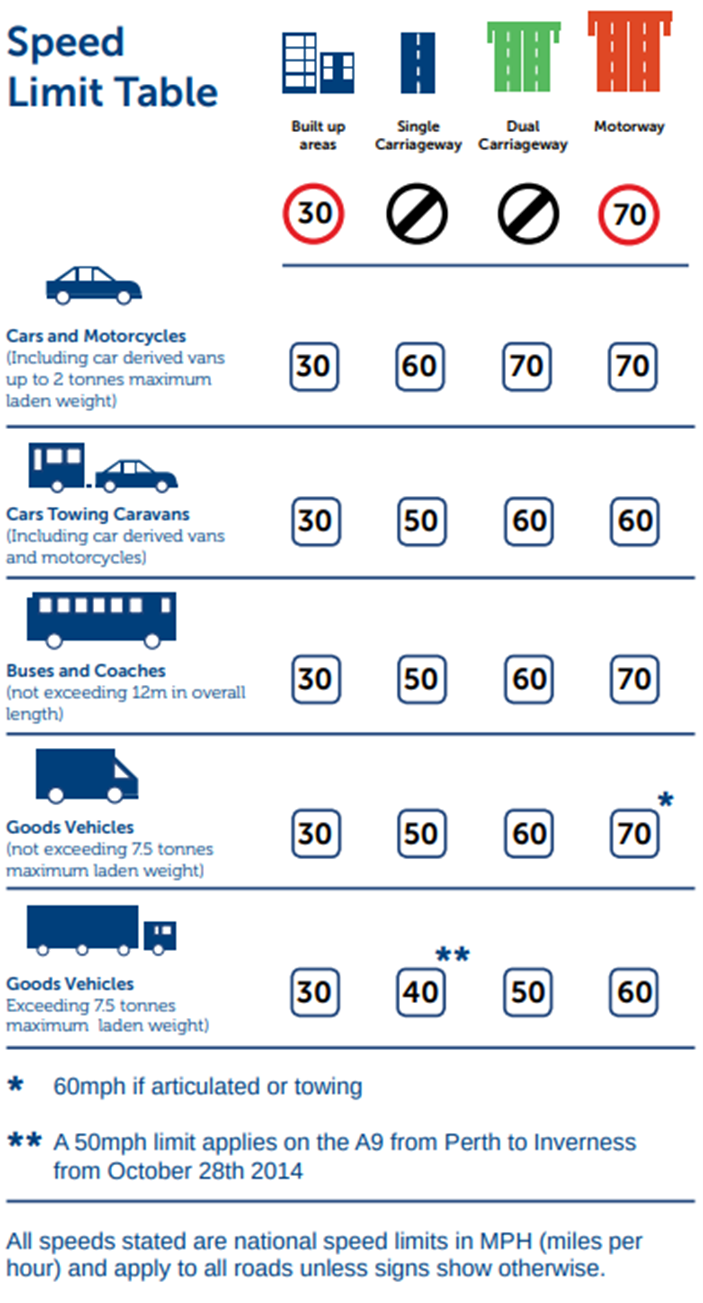
Speed limits are set for the safety of all road users and they vary according to the class of vehicle and the type of road.
The simple way to avoid speeding penalties is to know your limits and drive safely within them.
Please remember that the speed limit is not a target and you should drive at an appropriate speed for the road and weather conditions.
The national speed limits which apply to all roads unless signs show otherwise can be found at the end of this document.
Speeding is monitored through the vehicle telematics system and any drivers that exceed the speed limit can be investigated through the Councils disciplinary procedures.
Fines and notices
When a fine or notice is received this will be recorded by Fleet Services, investigated and passed to the relevant department to inform the driver.
All fines received will be expected to be paid privately by the driver of the vehicle at the time it was issued. If the fine is disputed then the driver must make contact with the appropriate authority or company to do this and advise of their correct contact details.
Falkirk Council will not pass on any private details except when required by law, specifically as requested by police.
Upon receipt of a Speeding fine, the following steps will be taken:
- Fleet Services receive speeding fines due to being the registered keeper of the vehicle
- Fine is then passed to the relevant department to complete section C (this is the name, address and contact details of the employee who was driving the vehicle at the time of the offence), this information is a legal requirement under Road Traffic Act 1988, Section 172.
- Once section C is complete the department must send this back to Fleet Services for it to be signed and sent back to Police Scotland (this confirms that we are the registered keeper however it was someone else driving the vehicle).
Reversing
Accidents involving vehicles reversing can result in serious injuries as well as considerable damage to vehicles, equipment and property. Reversing cameras must be used if they are fitted. You must also use a banksman whenever reversing if one is available.
The job of a banksman is to guide drivers and make sure the area behind the vehicle is free of pedestrians, vehicles and any stationary objects. If you are using a banksman make sure you understand the signals they are going to use and you keep them visible at all times. If a banksman is not available you must drive with all due care and attention to pedestrians, other vehicles and all other stationary objects when reversing.
Vehicle body props
If you are required to go under the body of your vehicle in the tipped or raised position you must ensure the body of the vehicle is securely propped using suitable equipment.
Emergency equipment
Appropriate first aid equipment will be supplied. Where a first aid kit is carried on a vehicle you must regularly check it to ensure that none of the items are out of date or missing. You must report any deficiencies to your line manager.
If a fire extinguisher has been discharged for any reason you should report it to your line manager to be recharged or replaced.
If any piece of emergency equipment is missing you must report the loss to your line manager as soon as possible.
Vehicle height
Before driving you must familiarise yourself with the travelling height of the vehicle. You must not drive a vehicle for any distance with the body in the tipped position.
Drivers hours and tachographs
Drivers of "O" licence (and certain non-"O" licence) Council vehicles have a legal obligation to keep particular records and adhere to the regulations governing drivers' hours. There are two relevant statutory provisions that deal with driver's hours:
Drivers must ensure that they are aware of the rules in relation to the Working Time Directive. In circumstances where drivers have voluntarily opted out of the Working Time Directive, the domestic (GB) or EU rules and how they apply to their particular Service must be fully explained to the driver by their manager/ supervisor.
The applicable driving rules will still apply regardless if the employee has opted out of the Working Time Directive.
Analogue records: Driver must retain the original records for the current day and the previous 28 calendar days and return charts to Fleet Services within 42 days of completion.
Digital tachograph: Where a vehicle is fitted with a digital tachograph vehicle unit, only a driver with a digital tachograph drivers' smart card is permitted to drive.
Drivers must upload their cards at least once every 28 days but where possible this should be done every 7 days.
Before taking over a vehicle, the driver should immediately insert their driver card into the vehicle unit. The driver must ensure that that the vehicle unit is fitted with a printer roll and a minimum of two spare rolls.
Drivers must report any lost or damaged card to the DVLA as soon as possible and can drive for up to 15 days while awaiting a replacement card. Printouts must be taken at the start and end of duty during this period. Drivers that have forgotten their card when starting any given shift they must not driver until the card is available.
Drivers must be able provide to enforcement agency staff, their driver smart card or any analogue charts for the current day and previous 28 calendar days and/ or any legally required manual records for the same period.
Employees must not tamper with, amend, alter or interfere with the workings of any tachographs or vehicle units fitted within a Council vehicle. Employees who tamper with tachographs or vehicle units, including charts, digital cards or the manual records sheets, may be subjected to legal action and investigated and dealt with in accordance with the Council's Disciplinary Policy and Procedures.
Managers/ supervisors must, wherever practical, limit the number of driving hours accrued in order to minimise the risk of driver fatigue. This is particularly important in winter gritting operations or where employees are on standby duties which require to be carefully managed to ensure that drivers are given adequate rest periods.
Below is an overview of the EU and domestic driver's rules. Drivers should be aware of which of the rules applies to the type or work they are carrying out.
EU Rules
| Limits | Notes | |
|---|---|---|
| Maximum Driving Times | 9 hours maximum daily driving time (can be increased to 10 hours twice a week). Weekly driving time limit 56 hours and 90 hours in any 2 consecutive weeks. |
The provisions of the Transport (Working Time) Regulations must also be respected, ie working time not to exceed 60 hours in a week or 48 hours average in any reference period. |
| Breaks | 45 minute break in or immediately after a 4.5 hour driving period. | Can be split into a 15 minute break followed by a break of at least 30 minutes. |
| Daily Rest | Regular daily rest is 11 hours. | Can be reduced to 9 hours no more than 3 times between weekly rest periods. |
| Weekly Rest | May be reduced from 45 hours to 24 hours once a fortnight. The other weekly rest period for that fortnight must stay at 45 hours. | Any reduction in weekly rest must be compensated by an equivalent rest added to another rest period of at least 9 hours. |
British Domestic Rules
| Limits | Notes | |
|---|---|---|
| Maximum Driving Time | 10 hours | This is the maximum driving permitted in any 24 hour period. |
| Maximum Duty Time | 11 hours | This is the maximum duty in any 24 hour period. This is the total time spent driving and carrying out other work. |
Passenger Carrying Vehicles (Section 19 Minibus Permits)
Organisations such as our own can apply for a Minibus Permit, (Section 19 -Transport Act 1985) for vehicles that can carry between 9 and 16 passengers.
Section 19 Permits must be displayed in the windscreen of any minibus operating under this scheme.
This includes minibuses that may be under temporary hire arrangements. Permits are available on request from the service department or the fleet management unit. Section 19 permits are only applicable to the United Kingdom.
Vehicle Tracking Devices, Cameras and Telematics Identified fleet vehicles are fitted with vehicle telematics systems that allow the live tracking of the vehicle.
Drivers are issued with a unique tracker fob to identify the driver before driving the vehicle. Fobs should not be shared or used by anyone other than the driver the fob was allocated to.
Fleet vehicles are fitted with recording cameras and in some vehicles screens to assist the driver with manoeuvring.
Any interference with telematics devices, cameras or recording devices can be clearly identified both in the vehicle and by Fleet Services. Deliberate attempts to disable any of the components will be investigated in accordance with the Council's Disciplinary Policy.
Roadside inspections
You must report any roadside inspection by DVSA or the Police to your line manager within an hour of it taking place.
Economic driving
Costs associated with the vehicle fleet will be reduced wherever practical through the provision of a fuel efficient fleet, which are properly serviced and maintained. The Council is also committed to its environmental responsibilities through the reduction of vehicle emissions which includes the continued expansion of the electric vehicles fleet.
Fleet Services will monitor fuel consumption on a regular basis with the aim of improving our fleet efficiency, while drivers also have a key role to play in helping to achieve these aims and commitments by following the fuel saving tips which are listed below. These tips will not only improve the mpg in a fossil fuel vehicle but also improve the range of electric vehicles:
Pre-use
- Check oil and water levels daily.
- Vehicles requiring fuel should be filled until the fuel reaches the bottom of the filling neck and no further. Overfilling in in warm conditions will cause the fuel to expand and can leak from the filler.
- Tyres must be maintained at the correct pressure, 10% lower than the correct pressure equates to a 1% increase in fuel consumption.
- Report all defects, brakes that are binding can increase fuel consumption by up to 15%.
When driving
- Avoid harsh acceleration and braking, this can increase power usage and decrease energy recovery in electric and waste fuel in fossil fuel vehicles.
- Watch your speed, as with any car the faster you go the more fuel you use. A 5% increase in speed can increase fuel consumption by 20%.
- Anticipate the traffic ahead, adjust your speed to avoid having to stop.
- Never leave an engine running if it is not required, on average, for each hour of idle running an engine can use in excess of 1 litre of fuel.
- Never over rev. an engine when starting up - start up and move off to warm the engine up.
- Use the correct gear when moving off and driving.
- Keep the engine revs in the "Green band" for as long as possible.
- If the vehicle has an 'Eco' mode then use it.
Electric Vehicles
When driving Electric Vehicles remember:
- Electric cars have instant power and can accelerate quickly - drivers should be careful when accelerating and be aware that it will use more power. Keep electric 'rev counter' in the eco range.
- Driving mode - ensure that the vehicle is in the 'Eco' or 'Eco+' drive mode where the vehicle is most efficient. In extreme winter conditions, consider the best approach, whilst being mindful of the environment.
- Avoid harsh braking - electric vehicles have regenerative braking which quickly reduces the speed just by taking the foot off the accelerator pedal
- Noise - newer electric vehicles will make an artificial noise when driven at slow speeds but in all electric vehicle drivers must be wary of pedestrians that may not hear them approaching.
- Speeding - exceeding the road speed limit is illegal and excessive speed will provide poorer fuel efficiency. As well as keeping below speed limits try to limit top speed travelled, for example drive at 50mph on 60mph limit roads.
- Temperature - set temperature control timer to heat vehicle when connected to charger and avoid using air conditioning in summer to increase range.
- Conserve momentum - anticipate the road and traffic ahead to minimise acceleration, braking and ultimately starting/stopping to maximise energy consumption.
Vehicle charging
When using the Vehicle Charging Network (Council and public charging points):
- Treat fellow network users with respect whilst making use of charge points.
- Only park in a charge point bay if you have an electric or hybrid vehicle.
- Only park in a charge point bay if you intend to charge the vehicle.
- Only use the charge point if you genuinely need a charge.
- Do not remove another vehicles cable or use another vehicles cable without permission.
- Ensure that your vehicle has started charging before leaving the vehicle.
- Use the relevant charge card when ending charging sessions.
- Remove your vehicle cable from the charge point when you are finished.
- When connected to a rapid charger limit your use to a maximum of 1 hour.
- Remove your vehicle as soon as you are able to do so once your vehicle has been fully charged.
Electric Vehicle charging guidance
- All electric vehicles are issued with a charge card that should be kept with the vehicle and not transferred.
- Vehicles will have at least 1 charging cable, this is a type 2 cable for use with public charging points. Some vehicles may also have a mains charging cable for use in emergency.
- Cables must be kept in the vehicle when not being used and never left attached to the charger.
- Access to the charging port on the vehicle varies depending on make/model, some require buttons on the keys or in the vehicle to be pressed to gain access.
- To activate the charger present the card to the unit, pictogram on unit will show where to do this.
- Connect the cable to the vehicle first before plugging into the charger and when completed charging remove from the charger and then the vehicle last.
- Once done follow on screen instructions and plug cable into side as directed.
- Always ensure that the vehicle is charging before locking and walking away.
- To disconnect again present the card to the unit and follow the on screen instructions.
- Do not attempt to disconnect the cable until instructed.
- If the charger has not unlocked the cable do not attempt to remove it, this may lock the cable in place. If this has happened push the cable back into the machine and start a charge session. Repeat previous instructions to stop the charge and remove the cable.
- When using a rapid charger the cable is tethered to the charger and will use a different charge port on the vehicle. Check which cable fits the port on the vehicle. * As with other chargers present the card where indicated and follow on screen instructions when connecting/dis-connecting.
- Drivers should return and remove vehicle from chargers as soon as the vehicle is fully charged and not leave connected for a prolonged time.
- Not all vehicles are suitable for use with rapid chargers, if in doubt contact Fleet Services.
- If there are any issues call the number displayed on the charger quoting the location and the charger reference number that is noted on the machine.
Winter driving
Make sure you are prepared for winter weather by taking some simple steps to stay safe on the roads. Before setting off on your journey:
- Check news reports for the condition of the travel route, particularly for lengthy journeys
- Keep your vehicle properly maintained and check that the brakes, lights, battery, windscreen and wipers are in good condition
- Check the condition of your tyres for tears or bulges regularly as this can weaken the tyres
- Make sure tyres have at least 2mm of tread and are correctly inflated to maximise grip on the road, consider winter or all-season tyres
- Check and replace the anti-freeze in the radiator
- Always ensure that your windscreen is properly demisted and clear of ice and snow before you drive – adding winter screen wash to the washer bottles will stop it from freezing
- Clear the roof of snow as this may slide forward and cover the windscreen
Additional Winter Driving Guidance: Some additional equipment that you may find helpful in specific weather conditions:
- Ice scraper and de-icer
- Torch and spare batteries
- Warm clothes, a pair of boots and a blanket
- Food and warm drink in a flask
- Shovel for snow
- Battery jump leads where appropriate
- First aid kit
- Sunglasses in the glove box for driving in low sun
- Make sure your phone is fully charged
If the weather conditions are really bad consider whether the journey is worth the risk or if alternative arrangements can be made. Services can request Winter maintenance pack from Fleet Services.
During your journey:
- Allow extra time for your journey
- Tell someone where you are going and when you expect to arrive
- Drive on gritted roads whenever possible and be aware of changing road and weather conditions
- Reduce your speed and increase stopping distances – braking distances in snow and ice are 10 times longer
- When on icy roads drive in as high a gear as possible, accelerate and brake very gently
- To minimise the risk of losing control drivers should slow down on straights prior to bends and steer smoothly round the bend
- Use dipped headlights where visibility is poor
Vehicle breakdown and recovery
Any breakdowns during working hours should be reported to Fleet Workshop.
Fleet Workshop opening hours
| Day | Opening hours |
|---|---|
| Monday | 8am - 4pm |
| Tuesday | 8am - 4pm |
| Wednesday | 8am - 4pm |
| Thursday | 8am - 4pm |
| Friday | 8am - 3:30pm |
Outwith workshop hours then the Out of Hours Helpline should be contacted.
If within the Falkirk Council boundary either a standby mechanic or recovery will attend. If out with the Falkirk boundary then recovery will be arranged within 60 miles of the boundary.
If outwith 60 miles of Falkirk Boundary then the AA Business Customer Hotline should be used.
- Account Number: 10321209
- Contract Number: BCASC764262
- Policy Number: BCASP764262
- Contact Number: 0800 581710
The driver must wait with the vehicle until either a mechanic or recovery agent attends.
Please note that the Falkirk Council recovery agent will only be able to provide safe transport for up to 2 people and the AA for up to 7 people.
Speed limits
Annual Authorisation to Drive
Please complete this on MyView.
Guidance is available: MyView - My Forms.